
Table of Contents
General
- PCM – Protection Circuit Module
- SU – Safety Unit
- BMS – Battery Management System
- Battery gauge – Monitors battery health, capacity, percentage etc
Resellers
Certification
Farnell's guide to batteries Also good info about certification.
- Transport – UN38.3
- CE – EN 62133-2
- UL – UL1642 (single cell), UL2054 (pack)
Lithium-ion
Farnell's guide to batteries Also good info about certification.
<WRAP group> <WRAP half column>
- Lithium ions move from the negative elecrode to the positive electrode during discharge.
- No memory effect
- Flammable electrolyte
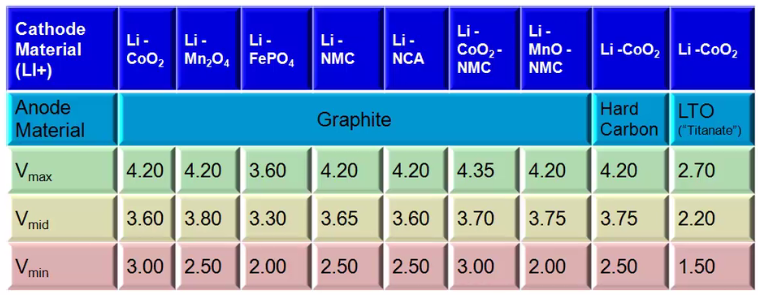
- 3.0 V - 4.2 V / cell (except for some electrodes)
</WRAP>
| Specific energy | 100-265 Wh / kg |
| Energy density | 250-693 Wh / litre |
| Specific power | 250-340 W / kg |
<WRAP half column> </WRAP> </WRAP>
There are several Lithium ion batteries. The ones with a polymer electrolyte (instead of a liquid) are called Lithium polymer batteries.
| Short name | Positive electronde, cathode during discharge | Negative electronde, anode during discharge | Nominal cell voltage | ||
| LCO | Lithium cobalt oxide | <chem>LiCoO2</chem> | Carbon/graphite | 3.6 V | |
| LFP | Lithium iron phosphate | <chem>LiFePO4</chem> | Carbon/graphite | 3.2 V | |
| LMO | Lithium ion manganese oxide | <chem>LiMn2O4</chem> or <chem>Li2MnO3</chem> | Carbon/graphite | 3.7 (3.8) V | |
| NMC1 | Lithium nickel manganese cobalt oxide | <chem>LiNiMnCoO2</chem> | Carbon/graphite | ||
| NCA | Lithium nickel cobalt aluminium oxide | <chem>LiNiCoAlO2</chem> | Carbon/graphite | 3.6 V | |
| LTO | <chem>LiMn2O4</chem> or <chem>LiNiMnCoO2</chem> | Lithium titanate | <chem>Li4Ti5O12</chem> | 2.4 V | |
1 Also NCM, CMN, CNM, MNC, MCN depending on metal combinations
Charging
- Pre-conditioning – Short-circuit test and trickle charge/pre charge
- Thermal regulation – Limits current to maintain temperature in the charger IC
- Constant current – Quick charge phase
- Constant voltage – Finish charging, stops completely after current threshold reached
All charging states are usually time limited, as a fault detection mechanism.
Charging a cell even 50mV higher than it's specified maximum voltage will drastically decrease the cycle life.
- Low current or simple solution might allow for use of linear charger.
- High current, or high efficiency, might require a switch-mode charger.
Power path (TI) allows system to work with a defective battery. It also allow the charger to monitor the charging current.
TI Training video – Battery charging